My Father in Stories
Updated: Sep 7
The Record, The Moments, His Voice, One Story at a Time

When my father died in 1991, his canned obituary was woefully inaccurate—in both spirit and fact. Names and places were wrong, and it said almost nothing about what he had accomplished in his lifetime.
It irked me for decades.
More than thirty years later, I finally wrote a truer version, and posted it on Facebook with a few photographs. The response from people who knew Dad—and people who knew our family across the years—was heartwarming. Remembrances of him after over thirty years since his death came pouring in as people added details, reactions and stories of their own.
Later, I wrote other family stories where recollections of my Father's voice played prominent:
 |  |  |
I wrote this piece first. It corrects the factual record. | This story preserves Dad's lifelong mantra to me. | A rare moment when my father could not contain his pride. |
 |  |
A reflection on a casual comment my father made about the aches of aging. His words resonate now as I embrace age sixty-five on the final stretch. | Dad surveys the shed he built and quips: “Good enough for government work.” Decades later, I finally answer him: Yes, it was, Daddy. Yes, it was. |
The record, the moments, his voice. That is how I remember my father.
Especially his voice.
Memoir Worthy ? Start Small
Each mention of Dad in these examples are individual, unique Stories, not Chapters for a book. Each were written separately, sometimes years apart, because one particular memory felt worth preserving at that moment.
I don’t need to write a book about my Dad. I just need Stories!

There are advantages to starting small. First, Each story, on its own, was quick to produce and complete — something finished. Second, short and snappy prose with primarily visuals that readers can easily engage (Story Portrait) - is a better way to start to get and build your desired audience over time. Third, each separate story has a new vibe - conversation, mention and emotive theme that I could share one at time, over time.
It is better for readers and gift recipients of whatever “memoir” form— audiences past, present and future— to be reminded intermittently with a new story and engaged long-term, rather then bombed with a one-and-done tome of a multi chapter life story. Length alone correlates with reduced readership participation, story completion, and audience comprehension.
A picture is a memory. A story is more.
My purpose and yours to preserve a message are many. Maybe something my daughters, my lifetime friends and surviving siblings and cousins could read and value in the moment the story is shared. Or Something Dad’s grandchildren and great-grandchildren might someday discover. Or to enjoy the memory myself over and over by reading and seeing the memory! A picture is a memory - a story is more!
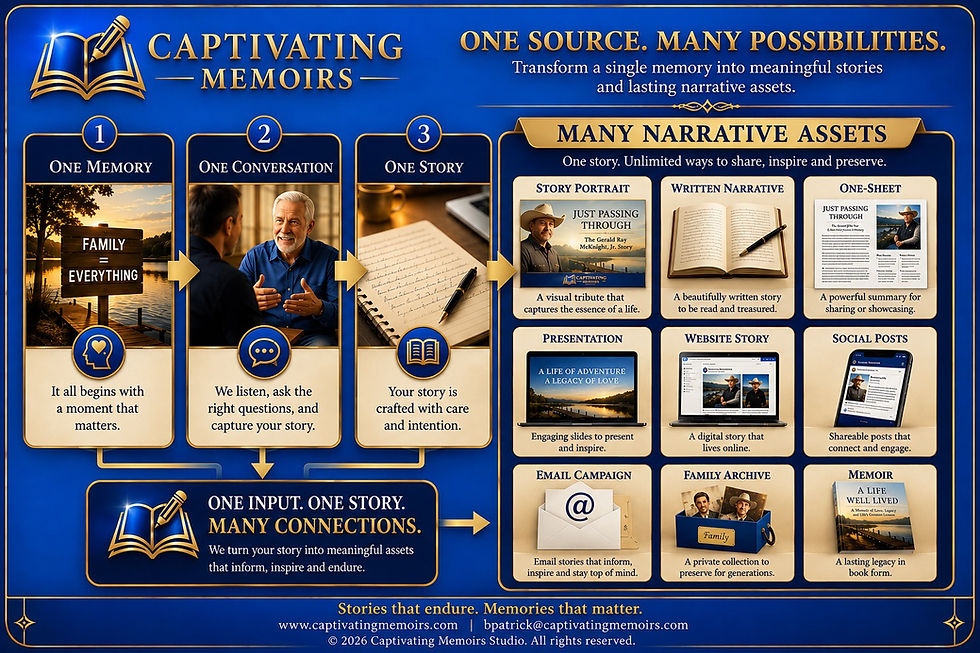
One Source. Many Possibilities.
Once a story is finished and approved, it becomes the Source. From there, that same source story can become different things for different audiences. A book does not have to be the destination for every story.
The story itself already has value:
More Than One Version of a Life
My father’s stories were never intended to be a connected set. They were written at different times, for different reasons and for different audiences. Each was complete in itself.
A life contains too many roles, relationships, contradictions, hardships, victories and small moments for one account to hold them all. There is probably no definitive story of any person.
There are just stories after stories!
Think of one story worth keeping:
The saying your father always repeated.
The photograph you cannot throw away.
The Christmas everybody still talks about.
The mistake that changed your career.
The funny thing your mother did.
The person you wish your grandchildren could have met.
Start there.
Tell that story well, finish it and preserve it. Then, if another story calls to you, tell that one too.
One Story at a Time.
That is enough to begin.
Best,
B. Patrick Jensen
Captivating Memoirs Studio
Tools of Trade:
ChatGPT.
Google Workspace and Drive.
Wix.
Adobe Acrobat.
InDesign.
Photoshop.
Illustrator.
Firefly.
These tools form much of the working infrastructure I use today at Captivating Memoirs Studio.


Comments